
Paid Media
Yelp Request a Quote Best Practices: How to Win More Jobs from Every Lead

The Yelp Request a Quote best practices that win jobs: reply inside two minutes, open with one easy question about their problem, use the customer's first name, reference their specific issue, include a price range or a specific appointment time, and follow up at least eight times before you archive the lead. Those leads go out to several businesses at once, so response behavior decides the job far more often than price does.
The lead that just hit your Yelp inbox isn't yours yet.
When a homeowner taps Request a Quote, that message usually goes out to multiple businesses at once. Everyone gets the same problem description at the same time. Nobody has an advantage on price, on reviews, or on how long they've been in business. The only real advantage is what happens in the next few minutes.
We manage paid media and lead response for home service brands, and the pattern is consistent across every account. The company that wins the job is the one that replies fastest, sounds the most human, and keeps going after attempt two. Price decides it far less often than people expect.
So let's get into the Yelp Request a Quote best practices that actually move close rate, starting with the three rules that decide most of it before you ever send a message.
How does Yelp Request a Quote actually work?
A homeowner searches a category, opens a business, and taps Request a Quote. They describe the job once, and Yelp offers to send that same description to other businesses in the category at the same time. Most people take that option, because it costs them nothing and it gets them several quotes for one form fill.
The button is labeled Request a Quote on some profiles and Request pricing & availability on others, including sponsored results. Same flow behind both.
From your side, that means the lead arrives already in a race. Your reviews, your years in business, and your pricing all matter later. In the first ten minutes, the homeowner is looking at a list of messages and deciding which company sounds like it read their problem.
Yelp puts your response speed on the scoreboard before anyone messages you. Response time and response rate sit in the search result itself, right above the button:
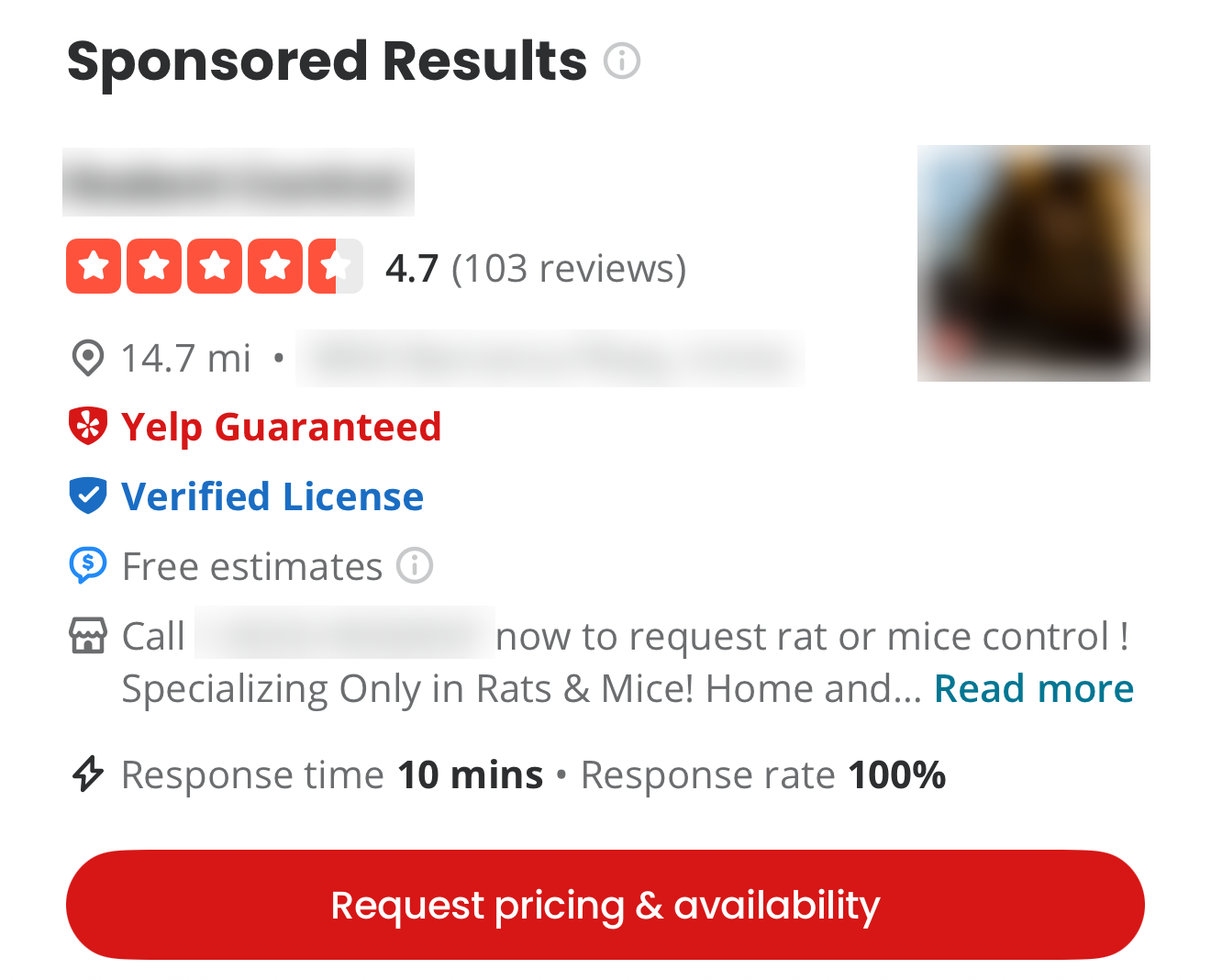
That's Yelp's own description of how it works. In its guidance for businesses, Yelp writes that when a customer sends you a direct request, "they're also given the option to send the same request to other related businesses."
How fast should you respond to a Yelp Request a Quote?
Inside two minutes. Yelp leads are perishable, and two minutes is the window where you're still the first or second voice in the conversation.
If your replies consistently go out two hours later, you're hoping the first three companies dropped the ball. That happens sometimes. It's a bad plan to build a month on.
Speed is an operations problem more than a marketing one.
Somebody needs to own the Yelp inbox by name. Push notifications need to be on. Overnight leads need to be handled first thing in the morning, before anything else on the schedule.
Should you ask for a phone number in your first Yelp message?
Ask a few exchanges later, once you've earned it. The most common mistake we see is the reply that opens with "What's the best number to reach you?"
Asking for a phone number before there's any rapport is the fastest way to get ignored, and it makes you sound like the six other automated replies sitting in that inbox.
Ask one easy question about their problem instead. Get a real dialogue going, and the number comes easily.
How many times should you follow up on a Yelp lead?
At least eight touches before you archive the lead. Most companies quit after one or two attempts. Most of the deals close somewhere between attempt five and attempt eight.
That gap is the entire opportunity. Beating your competition on Yelp doesn't require better pricing. It requires still being there on day three, when everyone else has moved on.
The 6-step Yelp Request a Quote response sequence
Run this same sequence on every lead. Don't skip steps, don't compress the timeline, and save the improvising until you've run it enough times to know what you're improvising against.
Scroll the table →
| Step | When | What you send |
|---|---|---|
| 01 First message | 0 to 2 minutes | Empathy plus one easy question about their problem |
| 02 Call, then time offer | Within 5 minutes | A phone attempt, then a message with a specific time |
| 03 Two time options | 6 hours later | A binary choice between two appointment slots |
| 04 Personality | Next morning | A message that sounds like the people who work there |
| 05 Call again, price range | Day 3 | A second call, then a message with a price range |
| 06 Final nudge | Day 5 | One light close-out message, then archive |
What should your first Yelp message say?
0 to 2 minutes
Empathy plus one easy question. No pitch, no phone number ask. Show them you actually read what they wrote, acknowledge the problem, and ask one question that takes five seconds to answer.
Send this
"Hi [Name], sorry to hear you're dealing with [problem]. Quick question: where are you noticing it most?"
That question is doing real work. It's easy to answer, it proves you read the request, and it opens a thread you can keep building on.
When should you call a Yelp lead?
Within 5 minutes
Pick up the phone right after the first message goes out. If they don't answer, send a follow-up through Yelp immediately with a specific time on the table.
Send this
"Just tried calling! We have availability as soon as tomorrow, would 2 PM work for a free inspection?"
There's no open-ended question in there. You're offering a time, which keeps the planning work on your side of the conversation.
What should your first follow-up say?
6 hours later
Give them two specific time options. "What day works best for you?" hands the work to the customer, and busy people answer the easy message first.
Send this
"Hey [Name], still happy to help with those [pests]. Would tomorrow at 10 AM or Thursday at 2 PM work better for a quick look?"
Two options converts better than an open calendar, every time.
How do you keep follow-ups from sounding templated?
Next morning
Let your brand sound like a company run by actual people. You've been professional and specific for three messages, which earns you the room for a little humor or confidence. That's what separates you from every stiff, templated follow-up in the inbox.
Send this
"Our techs have the gear loaded up and ready, just waiting on you. Want to get this knocked out this week?"
Should you give a price before you've seen the job?
Day 3
Give a range. Try the phone one more time first, and if there's no answer, send a message that puts a range on the table.
A range reads as transparent, it removes the fear of an unknown quote, and it leaves you room to quote accurately once you've seen the property. A single number does the opposite on all three.
Yelp supports this directly. When you send an estimate, you can send it as a flat rate, a range, or an hourly rate, alongside your available times and a personal message.
Send this
"Just tried you again! For a job like yours, most customers land in the $150 to $250 range depending on what we find. Want to lock in a time this week?"
When should you stop following up on a Yelp lead?
Day 5
One last message, then archive it. Keep it light and leave the door open. Guilt has never booked a job.
Send this
"Last check-in from us, [Name], no worries if the timing wasn't right. If you ever need help down the road, we're always here."
If there's still nothing after this, archive it and move on with a clear conscience. You ran the full sequence.
What should you do the moment a Yelp lead replies?
Answer the question they asked. This is where a lot of good sequences fall apart: the lead responds, and the rep immediately asks for a cell number.
Earn it first. Answer what they asked, build a little rapport, stay human for a few exchanges. Then ask:
Send this
"Mind if I grab your cell? Easier to coordinate from there."
Asked at the right moment, that gets a yes almost every time. Asked in message one, it gets silence.
What separates a winning Yelp reply from an ignored one?
Print this one and put it in front of whoever owns the inbox.
Scroll the table →
| Do this | Avoid this |
|---|---|
| Use their first name in every message | Asking for a phone number before you've started a conversation |
| Reference their specific problem, "ants in the kitchen" | "What day works best for you?" |
| Ask specific, easy-to-answer questions | Copy-paste messages that read like a form letter |
| Offer two time options | Waiting more than two hours to respond |
| Give a price range | Quoting a single number sight unseen |
| Use both channels, call and message | Skipping the phone call entirely |
| Follow up 8 or more times before archiving | Giving up after one or two attempts |
| Check Yelp messages first thing every morning | Letting overnight leads sit until the afternoon |
What are the 3 things Yelp asks for in every quote response?
Yelp publishes this guidance itself. It tells businesses that people requesting a quote want a fast, detailed response with a price estimate and availability, and that a good reply stands out with personalized information and clear next steps. Boiled down, that's three things, and they all fit in your first message.
Two of the three are handed to you. The homeowner doesn't type a paragraph, they answer a short multiple-choice intake, so the pest and the job type arrive already sorted:
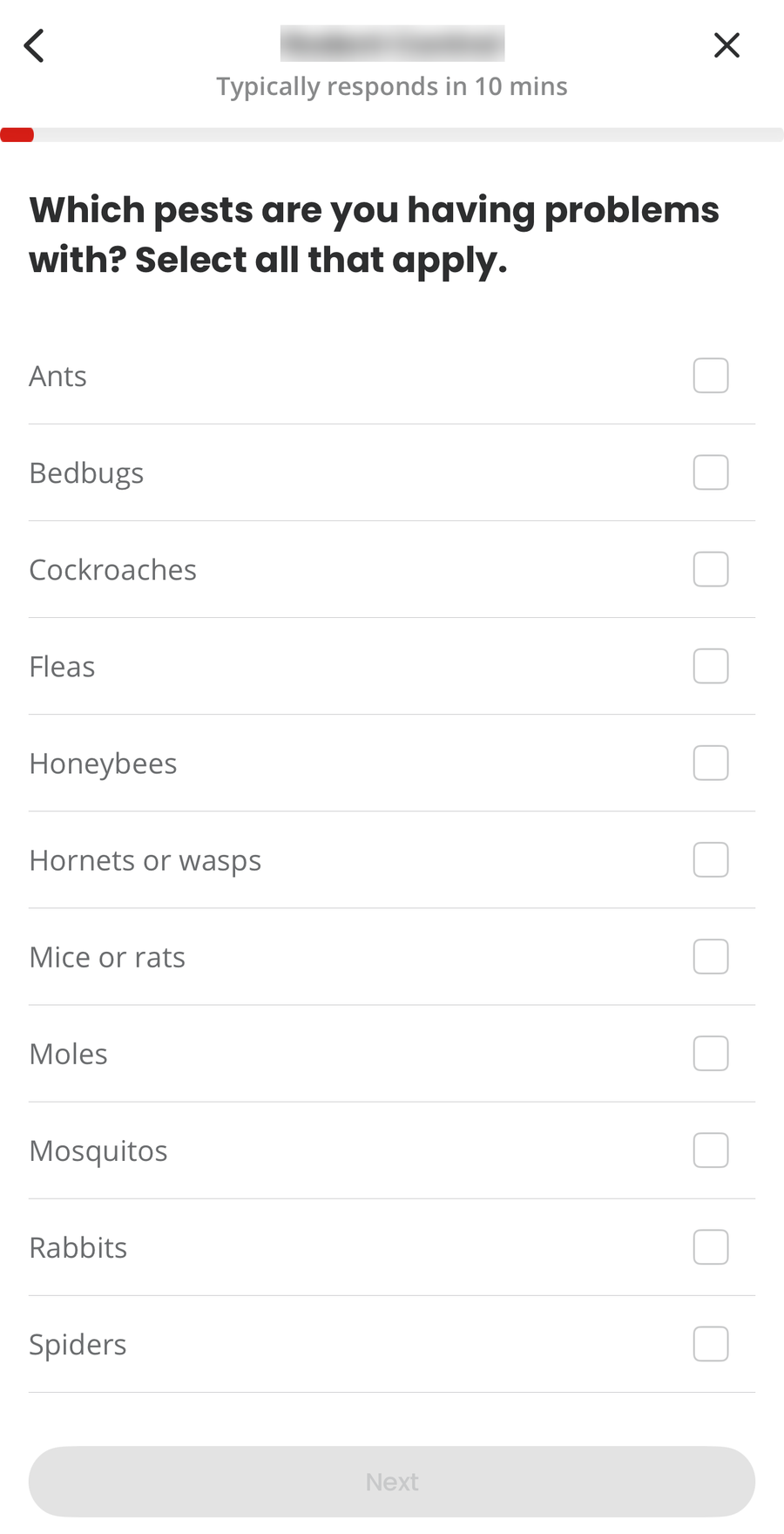
So a reply that says "your pest problem" is throwing away information the customer already gave you. They told you it was mice, in a specific room, and that they want it exterminated rather than inspected. Say that back to them.
Yelp's tips for turning job requests into sales go further and suggest itemizing the estimate where you can, so the homeowner can see what the materials, the labor, and the timeline each cost.
- Use their name. Address the lead by first name in your opening reply. It signals a person wrote it.
- Reference their specific problem. "Ants in the kitchen" beats "your pest problem." Name the pest, the room, the symptom, whatever they gave you.
- Include a price range or availability. Either one satisfies the criterion. Both together is stronger, and it usually speeds up the reply too.
Hit all three consistently and you get the compounding benefit: faster replies from customers, and a response time and response rate on your listing that make the next homeowner more likely to pick you. Miss them and you're spending the same on ads and the same hours of your team's time for a worse result.
How do you make Yelp lead response stick month after month?
The sequence above isn't hard. Running it on every single lead, at 7 AM on a Saturday, in month nine, is hard. That's where most companies actually lose.
A few things that make it stick:
- One owner. Somebody's name is on the Yelp inbox. A person, not "the office."
- Saved templates, personalized manually. Templates for speed, custom details for the win. Every template gets touched before it goes out.
- A morning sweep. Overnight leads get handled before the first appointment of the day.
- Response time tracking. Measure median first response in minutes. Anything you can't see will drift.
- Attempts tracking. Count follow-ups per lead. If your average is three, you're leaving jobs on the table and you can prove it.
Is Yelp Request a Quote worth it for home service businesses?
Check two numbers before you answer that: your median first response time and your average follow-up count per lead. In most accounts we audit, the channel is delivering and the response process is the leak.
This is the same pattern we see with Google Ads campaigns that aren't converting. Traffic gets all the attention, and the conversion step downstream of it never gets built. A Yelp lead that sits for four hours and gets two follow-ups looks exactly like a bad lead source on a spreadsheet.
Fix the response process first. If the numbers still don't work after eight touches and a two-minute median, then you have a real answer about the channel.
Speed, specificity, and persistence. That's the whole playbook, and it's available to you today without spending another dollar.
Quick Answers
How fast should you respond to a Yelp Request a Quote?
Inside two minutes. A Request a Quote goes to several businesses at the same time, so the first credible reply sets the tone for the whole conversation. Replies that land two hours later are competing for whatever is left after the first three companies have already talked to the homeowner.
Do Yelp Request a Quote leads go to multiple businesses?
Yes. When a homeowner submits a Request a Quote, Yelp sends that same project description to multiple businesses in the category at once. Nobody has an advantage on price, reviews, or years in business at that moment, so response speed and specificity are what separate the replies.
How many times should you follow up on a Yelp lead?
At least eight touches before you archive it. Most companies stop after one or two attempts, and a large share of the jobs that do close land somewhere between attempt five and attempt eight. Persistence past attempt two is available to any business today without spending another dollar on leads.
Should you ask for a phone number in your first Yelp message?
Ask later, after a few exchanges. An opening message that asks for the best number to reach them reads like the other automated replies in the inbox and gets ignored. Lead with one easy question about their problem, answer what they ask back, then request the cell number once there is a real conversation going.
What does Yelp say to include in a Request a Quote response?
Yelp tells businesses that people requesting a quote want a fast, detailed response that includes a price estimate and availability, and that a reply should stand out with personalized information and clear next steps. In practice that means three things in your opening message: their name, their specific project, and a price estimate or a time you can be there.
Should you give a price on Yelp before seeing the job?
Give a range rather than a single number. A range like "$150 to $250 depending on what we find" reads as transparent, removes the fear of an unknown quote, and leaves room to quote accurately once you have seen the property.
What should you do with Yelp leads that come in overnight?
Handle them in a morning sweep before the first appointment of the day. Overnight leads have already lost their speed advantage, so the recovery move is to be the first message the homeowner sees when they pick up their phone in the morning.
Why are my Yelp leads not converting?
Check median first response time and average follow-up count before you judge the channel. In most accounts we audit, leads are arriving fine and the response process is the leak: replies going out in hours instead of minutes, templated messages that never name the problem, and follow-up stopping at attempt two.
Keep reading:
- 11 CRO Non-Negotiables Before We Touch Ad Spend, by Kim Fitkin
- Why Your Google Ads Campaigns Aren't Converting (And the 3-Part System to Fix It), by Kim Fitkin
- 13 Google Ads Mistakes That Are Quietly Draining Your Budget, by Matt Nelson